How to play
Center Court
Serve, rally, and win three games to take the set.
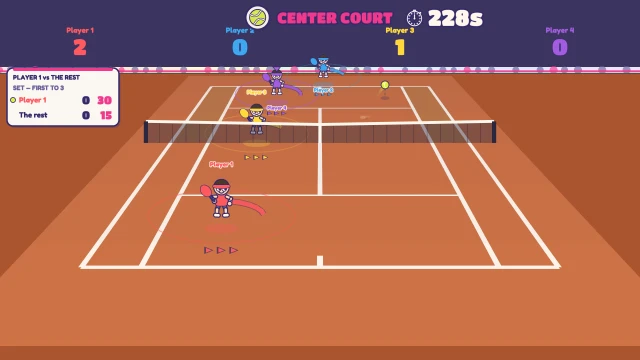
At a glance
- Players
- 1–4 at once
- Ages
- 6 and up
- Round
- Minutes — a sit-down game
- In the packs
- Party, Arena, Big Kids
Controls
The stick and button 1 are enough to play. The rest add moves for the older kids.
| What you press | What it does |
|---|---|
| Stick | move; aim while you swing — sideways for direction, forward for depth |
| Button 1 — the big button | hold to wind up a drive, let go to hit; it also tosses and hits the serve |
| Button 2 | lob (hold to wind up) |
| Button 3 | drop shot |
| Button 4 | dash — spends one pip of the gauge |
How a round goes
A set is first to three games, two clear, with a five-point tiebreak at two games all and a four-minute cap. Points go 15, 30, 40, deuce and advantage — the real thing with the middle cut out. Serve changes ends every game.
Serving: press button 1 to toss. The ball goes up, and how high it is when you hit it is your power; press again, let go, or simply keep holding and it fires itself near the top of the toss. Let the toss land untouched and it is a fault. A serve into the net or outside the box is a fault too; a second serve is pulled in safer, and a double fault is the point lost.
Rallying: a coloured ring on the court shows where every ball will land, in the colour of whoever should play it, and it shrinks as the ball comes down — a wide ring means you have a second, a tight one means swing now. Hold a shot button and a ring fills at your feet, going green when full; let go to swing, or keep holding and the swing fires itself as the ball drops into reach. A tap is the control shot, safe and to mid-court; a full wind-up is the power shot, hard to return and easy to spray if you are stretched. While you hold, you run at half speed. Power costs you your legs.
Button 2 is a lob, slow and high, for a net-rusher. Button 3 is a drop shot, a touch just over the net, and it barely charges. Any swing at a ball above shoulder height is a smash; a pulsing green ring on the ball and a SMASH! badge over your head say when one is on.
Winding up earns pips on the three-pip gauge under your feet; button 4 spends one on a short dash, straight at the ball if the stick is centred. A player who only ever taps never has a dash to spend.
Scoring and winning
Ball out, into the net, or bounced twice is the point lost. First to three games takes the set; at the four-minute cap the leader takes it on games, then the game in progress, then points; dead level is a draw.
Alone you play Robo, who is always a little slower than you, so a corner properly played is a point won. Two players is singles. Four players with the team row on is doubles, stations 1 and 3 against 2 and 4. Three players, or four without teams, is one against the rest: station 1 defends the singles court alone while the pack must defend the doubles court, and the tramlines show which is which. Each player's own column counts the points they personally won.
Tips
- Arrive late and the shot is weak, always. Move first, wind up second.
- Charge to earn, dash to spend. The dash is the difference between reaching a wide ball and watching it.
- The shadow is the game. The ball itself only tells you how high it is.
- A second serve is safer than the first, which is why a child who faults once rarely faults twice.