How to play
Knockout Ring
Punch, block and duck your way through three rounds — or knock the other boxer down for good.
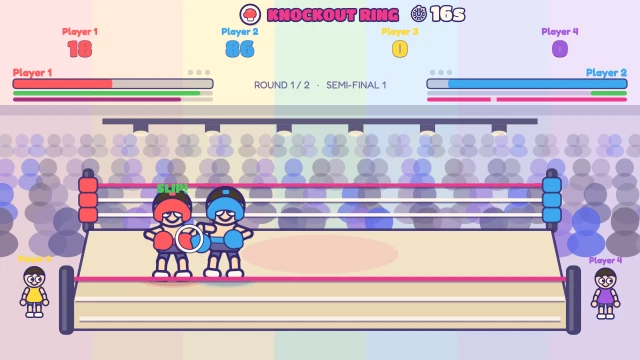
At a glance
- Players
- 1–4 at once
- Ages
- 7 and up
- Round
- Minutes — a sit-down game
- In the packs
- Party, Arena, Big Kids
Controls
Button 1 does the main thing. The other buttons add moves, and the ready screen shows which ones this game uses.
| What you press | What it does |
|---|---|
| Stick | move; pull down to duck |
| Button 1 — the big button | jab — and mash it to get up from a knockdown |
| Button 2 | hook |
| Button 3 | block (hold) |
| Button 4 | uppercut — needs a full power meter |
How a round goes
A Title Fight is three rounds of forty seconds, with a walk to the corners between them and a full stamina bar at the start of each. The ring is small on purpose: two boxers who both run away are back inside hook range in a couple of seconds, so a bout cannot stall.
The jab is fast and light; the hook is slower and harder; the uppercut is the big one, and it is not a button so much as a meter — landing punches, taking them on the guard and even taking hits fills it, and only a full meter lets you throw it. Every punch winds up before it lands, and the windup is the whole game: the arm cocks back where the other player can see it, and it is the only moment a counter can land. Hit someone during their windup and your punch does nearly double and cancels theirs.
Every defence answers exactly one attack and loses to another: a raised guard eats a jab whole; the uppercut comes up underneath and breaks the guard; a hook sails clean over a ducking head; and a hook catches you on the way up out of a duck. There is no button a child can simply hold down and win with.
Stamina pays for everything. Punches cost it, being hit costs it, and holding the guard drains it — a guard held from full lasts about five seconds, far less under fire. At zero you are gassed: weak, slow punches and no blocking until you stop throwing for a moment. Out of breath means hands down.
Health at zero is a knockdown. The referee counts to ten; mash button 1 — eight presses beats the count — and you get up with two thirds of your health. A third knockdown is a TKO, whatever your thumb can do.
For one child, or a pair, the setup card's ▲▼ row has more than the Title Fight: a Belt Run, which swaps the single bout for a climb. The row reads TITLE FIGHT first — what you get if you never touch it — then BRONZE (4 fights), SILVER (6) and GOLD (8). A fight is two rounds of thirty seconds against a Robo, won by knockout, TKO or on points, and dead level goes to the climber. Big Bell and Champbot are always the last two. Between fights a ladder card shows the climb: a star for every fight won, and the gloves you have left.
Every Robo has one trick a child can say back. Rookie only jabs, one-two, then rests. Swingbot's swirly glove spins round before the big hook: duck. Shellbot hides in its shell: the punches it stops crack it, and six cracks or one uppercut break it. Boingbot bounces in, hits and bounces out: hit it on the way in. Copybot's visor learns a punch you throw three times in a row and blocks it, so mix them up. Twinbots are two small Robos, one after the other, and you get a quarter of your health back when the second walks in. Jabs just go ding off Big Bell, which rises on tiptoe and then stomps: step back. Champbot does every Robo's trick, and stops to pose for the crowd. Win a fight with no knockdown and a counter, and once a run a Golden Robo drops in for a twenty-second bonus round: it cannot knock you down, and every hit scores.
Robo gets a level harder for every fight you win and a level easier for every fight you lose, inside a range that is higher on the longer belts. You have three gloves: a lost fight spends one and is fought again, and the fourth loss ends the run. On the Little Kids profile there are no gloves to lose, and Big Bell's armour and Copybot's block are off. Fifteen minutes of play end any run where it stands.
Before some fights comes a twenty-second drill in the skill the next Robo tests, with nothing to lose: no drill hurts or costs a glove. On the pads, hit the one that lights up — button 1 for high, 2 for the side, 4 for low. On the speed bag, hit it as it swings back to you. In dodgeballs, duck the high ones and block or bop the straight ones. What you score charges your big punch, and a ★ on the card means your uppercut is ready at the bell. Bronze has one drill, Silver two and Gold three, and a fight you lose is fought again without its drill. On the Little Kids profile any button answers.
Once a run, before the first bell, you pick a style: ◄ ► to choose and button 1 to lock it in, or it locks itself after eight seconds. Everyone shares the same punches. A style is a body and one signature move, thrown with the button a child already knows: hold button 1 for a moment and let go, and a plain tap is still a jab. Rocket flies in with a jab, and is left open if it misses. Whirl swings a long spinning hook that hits twice. Boulder holds a rock guard that costs no stamina and shoves when you let go, so your next punch is a counter. Zip hops back out of a hook's reach, then counters. Every style can also chain a one-two-three: a clean jab opens a short window for a second punch, and then a third, a quick hook with a star burst, but only in rhythm — mashing never chains.
Win a belt and a shelf of gift boxes opens: ◄ ► to choose, button 1 to open, one gift for Bronze, two for Silver and three for Gold (if nobody does, the card opens the rest after eight seconds). Every box holds something your seat does not have yet: a glove pattern (stars, stripes or dots) or a headguard sticker (star, heart or moon). What you win belongs to your player seat for the whole party and is worn in every later Belt Run, never in a Title Fight.
With two players the row reads TITLE FIGHT, TAG TEAM · BRONZE and TAG TEAM · SILVER — Gold is sixteen rounds to share. The pair climb one Belt Run together, a round each, and each picks their own style. The partner waits at the edge of the ring, and when the child in the ring is counted out the partner tags in, on the same clock. A fight is lost when both are out, or when Robo has done more damage than the pair at the bell. A friend who presses START during a Belt Run or a Tag Team joins as a tag partner, up to three children; a Title Fight is never interrupted.
Scoring and winning
In a Title Fight: knockout, TKO, or the final bell. A bout that goes the distance is decided on damage dealt; dead level is a draw. The scorebar counts your damage across the night, and alone it goes to the leaderboard.
One or two players is a single bout; alone you fight Robo. Three or four players is a knockout cup in one sitting, each bout cut to two rounds of thirty seconds. With three, station 1 fights 2 and station 3 gets a bye straight to the final. With four, 1 fights 2 and 3 fights 4, and the winners meet in the final.
A Belt Run scores the climb: 1,000 a fight won, 200 a knockout, the drills' points and the damage, and none of it goes to the leaderboard. Win the top fight and the TV says who has won the belt; run out of gloves or time and it says Champbot waits at the top, and offers the rematch. A Tag Team wins the belt together, and the card names the MVP, whoever landed the most.
Tips
- The answer to a hook is not to back off but to beat its long windup with the fast button. A jabber is always inside hook range.
- A whiffed hook or uppercut is the biggest opening in the game. Wait for one.
- Gassed is not a fail state, it is the rhythm: the child who learns to stop throwing for a second and a half wins more easily than the one who only mashes.
- Robo saves its uppercut for a guard it can break. That is exactly what you should do to it.
- Each drill teaches the rule of the Robo after it: the pads, the hook that cracks Shellbot's shell and the uppercut that breaks it; the bag, Boingbot's rhythm; the dodgeballs, the duck for Swingbot, Big Bell and Champbot.
- Hooks, uppercuts, counters and a style's signature move get through Big Bell's armour. Jabs only go ding.
- Throw a different punch before the third and Copybot never learns.